Crane Signal Chart
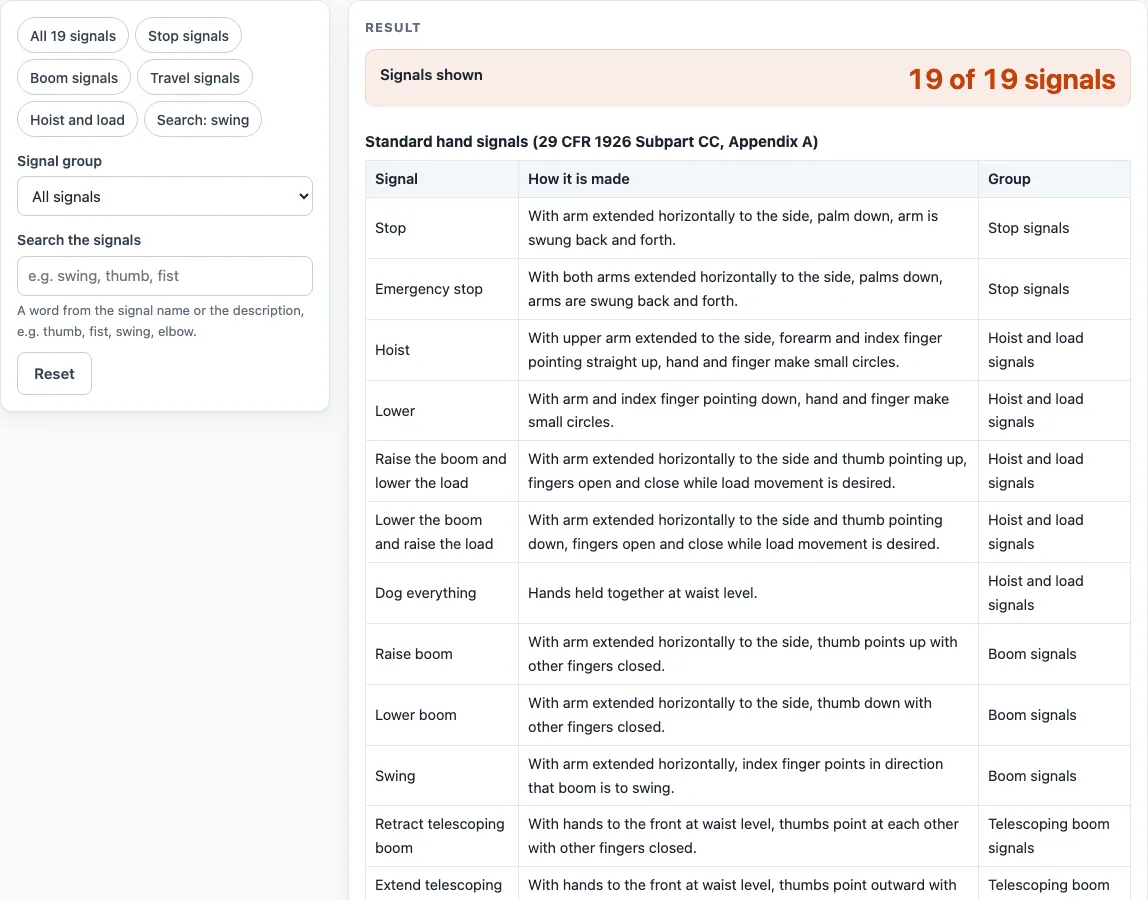
All 19 standard crane hand signals from OSHA Appendix A, described in words. Pick a group or search to find how a signal is made.
Recent
Your last 10 settings, saved only in this browser. Nothing is uploaded.
How to use the Crane Signal Chart
- Read the rows on the page. Each row gives a signal name and a description of how the signal is made.
- To narrow the list, pick a group. The groups are stop (2 signals), hoist and load (5), boom (3), telescoping boom (2), travel (4), and speed and hoist selection (3).
- To search, type a word from a signal name or description, such as “swing”. Every word you type must match a row, so add words to narrow the results.
- If nothing matches, the page shows “No signal matches”. Check the spelling or try a shorter word such as “boom” or “hoist”.
- For a quick view, open a preset: all 19 signals, stop signals, boom signals, travel signals, hoist and load, or a search for swing.
- When you find the signal you need, read the full description. Note the position of the arm, hand and finger it describes, and check whether the signal is given with one arm or both.
- For signals that depend on another signal, such as use auxiliary hoist (whipline) or use main hoist, read the lead-in movement first, then the regular signal that follows it.
- When you need an exact reference, compare the row with the published text of Appendix A and the hand signal chart posted at your site.
What is a crane signal chart?
A crane signal chart is the set of standard hand signals used to direct crane movements when a signal person and an operator communicate by hand. This page shows the 19 signals in the Standard Method of Appendix A to 29 CFR 1926 Subpart CC, each as a row of text because the text version of the appendix has no drawings.
Which rules apply to crane hand signals?
Under 1926.1419(b), signals may be given by hand, voice, audible or new signals. Under (c)(1), when hand signals are used, the Standard Method of Appendix A must be used, except where it is infeasible or does not cover an operation or attachment. Under (c)(2), non-standard hand signals must be agreed beforehand by the signal person, the operator and the lift director where there is one. Under (d), other kinds of signals may be used where the employer demonstrates they are at least equally effective.
Under (h), only one person gives signals at a time, except as allowed under (j). Under (j), anyone who is aware of a safety problem gives the stop or emergency stop signal. Under 1926.1422, hand signal charts must be posted on the equipment or conspicuously in the vicinity of the hoisting operations. These points are paraphrased, so read the regulation for its exact wording.
Do the signal rules cover general industry cranes?
29 CFR 1910.180 (crawler, locomotive and truck cranes, general industry) has no signals paragraph in the text read, so nothing here comes from it.
How are the travel and trolley signals made?
For crawler crane travel with both tracks, rotate the fists around each other in front of the body: away from the body means forward, towards the body means backward. For one track, indicate the track to be locked by raising a fist in front of the body, in the direction the other track is to travel.
For trolley travel, hold the palm up, fingers closed and thumb pointing in the direction of motion, and jerk the hand horizontally in the direction the trolley is to travel. For travel or tower travel, hold all fingers pointing up and extend the arm horizontally out and back in a pushing motion in the direction of travel.
Why does the signal wording need checking?
The wording here was read from the OSHA web page text of Appendix A. Typos in the published text were corrected (back and fourth, ttrack, horiontally, hel). In LOWER, the text read “arms and index finger pointing down”, shown here as “arm and index finger pointing down”. Compare the rows with the published appendix and the chart posted at your site before you rely on them.
What does the crane signal chart not decide?
The chart shows what the appendix says. It does not decide whether a signal person is qualified or whether a site may use signals other than the standard ones.
Sources (checked 15 October 2026): osha.gov · ecfr.gov · ecfr.gov
Worked examples
| Input | Result |
|---|---|
| group all, search - | 19 of 19 signals |
| group stop, search - | 2 of 19 signals |
| group travel, search - | 4 of 19 signals |
| group all, search thumb | 7 of 19 signals |
| group hoist, search small circles | 2 of 19 signals |
Calculated by the tool above; open it with the same values to see each step.
Frequently asked questions
How many signals are on the crane signal chart?
The chart lists 19 standard hand signals from Appendix A to 29 CFR 1926 Subpart CC. They are grouped as stop (2), hoist and load (5), boom (3), telescoping boom (2), travel (4), and speed and hoist selection (3).
Does this page show pictures of the signals?
No. The text version of the appendix has no drawings, so each signal is described in words only.
What is the difference between stop and emergency stop?
Stop is made with one arm extended horizontally to the side, palm down, and swung back and forth. Emergency stop is made with both arms extended in the same way.
Who can give a stop signal?
Under (j) of the rules shown with the chart, anyone who is aware of a safety problem gives the stop or emergency stop signal.
Can a site use its own signals instead?
Non-standard hand signals must be agreed beforehand by the signal person, the operator and the lift director where there is one. Under the rules shown, the standard method must be used when hand signals are used, except where it is infeasible or does not cover an operation or attachment.
Does the chart decide whether a signal person is qualified?
No. The chart shows what the appendix says and does not make that decision for any site.
Related tools
Crane Load Charts: use it when you want to look up load information for a crane.
Forklift Capacity Calculator: use it to work out capacity from the numbers you enter for a forklift.
Sling Angle Calculator: use it to work out sling angle results from your own inputs.
Lifting and Rigging: the hub for the sling, forklift and crane tools on this site.
Crane Inspection Checklist: use it when you want a printable crane and sling inspection sheet to fill in.
Equipment Inspection Checklist: use it when you want a printable equipment inspection sheet to fill in.
Forklift Inspection Checklist: use it when you want a printable forklift inspection sheet to fill in.