Fire Extinguisher Mounting Height Calculator
Enter the extinguisher weight and height to see how high its top and bottom may be, then check a mounting you already have.
Recent
Your last 10 settings, saved only in this browser. Nothing is uploaded.
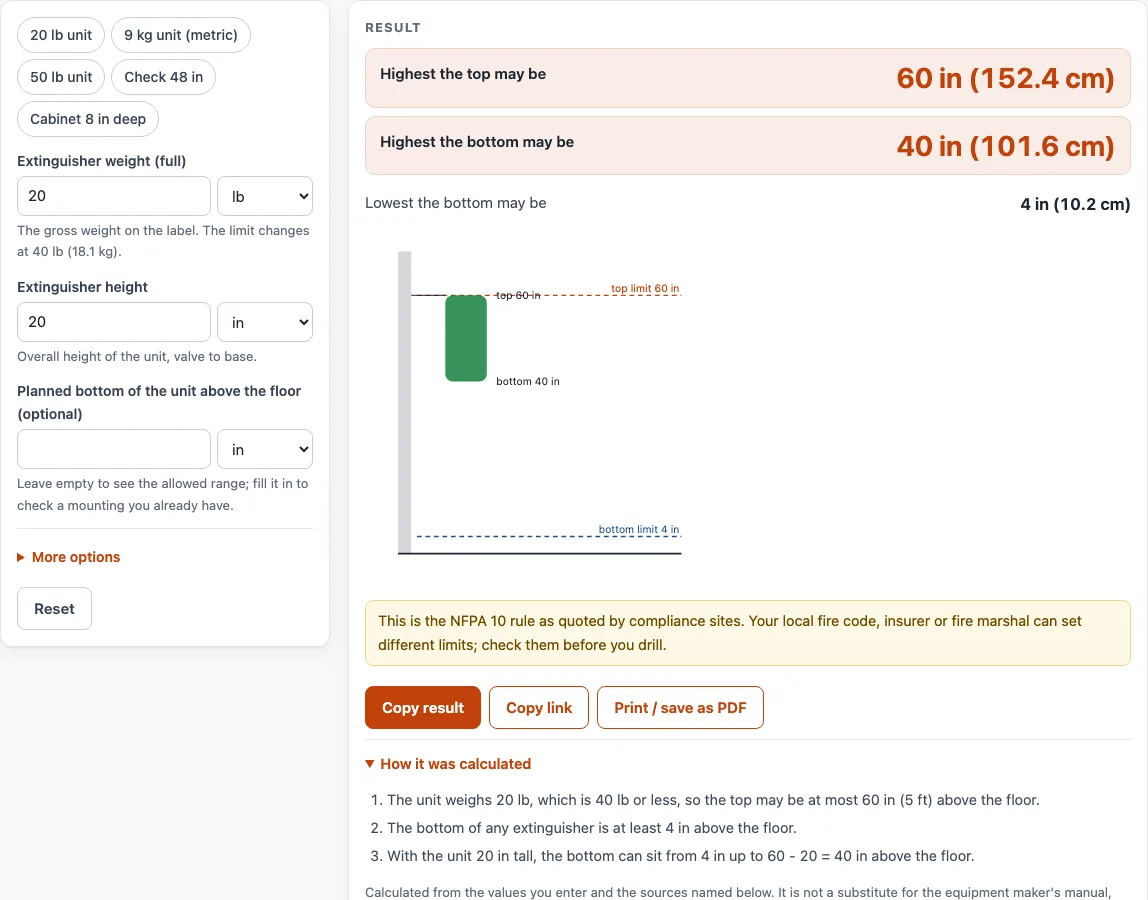
How to use the Fire Extinguisher Mounting Height calculator
- Enter the unit’s weight in “Extinguisher weight (full)” and choose lb or kg. Use the full weight printed on the label.
- Enter the overall height in “Extinguisher height” and choose in or cm.
- Read “Highest the top may be”, “Highest the bottom may be” and “Lowest the bottom may be”. The defaults are 20 lb and 20 in.
- To check a mounting you already have, enter the height of the bottom of the unit above the floor in “Planned bottom of the unit above the floor (optional)”.
- Read “Your mounting”. It says whether the placement is within the limits, too high or too low.
- To check a wall projection, open “More options” and enter the distance in “How far it sticks out from the wall (optional)”.
- Read “ADA protrusion check” to see the result for that projection.
- Look at the side-view diagram. The unit is green when it is within the limits and red when it is not.
The example buttons fill in sample values so you can see how the results change: “20 lb unit”, “9 kg unit (metric)”, “50 lb unit”, “Check 48 in” and “Cabinet 8 in deep”. The “How it was calculated” list shows each step, so you can follow how each limit was reached.
What are the fire extinguisher height requirements under NFPA 10?
NFPA 10, as quoted by two compliance sites (the J.J. Keller Compliance Network page dated 15 December 2025 and Kord Fire), sets the limits this calculator uses. An extinguisher weighing 40 lb or less has its top no more than 5 feet (60 in, 152.4 cm) above the floor. One weighing more than 40 lb has its top no more than 3.5 feet (42 in, 106.7 cm) above the floor. The bottom of any extinguisher must be at least 4 in (10.2 cm) above the floor.
The calculator uses the gross weight and treats exactly 40 lb as the lighter class. Because 40 lb is 18.14 kg, a unit entered in kilograms is compared on the same basis.
How does the fire extinguisher height change with the unit’s own size?
The highest bottom depends on the unit’s height. For a 20 lb unit that is 20 in tall, the top limit is 60 in, so the bottom may be between 4 in and 40 in (60 minus 20). For a 50 lb unit that is 24 in tall, the top limit is 42 in, so the bottom may be between 4 in and 18 in.
A 9 kg unit (19.8 lb) that is 50 cm (19.7 in) tall is in the lighter class. Its top limit is 60 in, so its bottom may be up to 40.3 in.
How do a fire extinguisher cabinet’s depth and lowest edge change the check?
A cabinet changes two numbers. Use the cabinet’s own outside depth in “How far it sticks out from the wall (optional)”, and use the height of its lowest edge when you check protrusion. The ADA protrusion check applies when the lowest edge is above 27 in and not more than 80 in above the floor. Kord Fire recommends about 36 in of clear access space around each unit.
Do OSHA or the ADA set a fire extinguisher installed height?
OSHA 29 CFR 1910.157(c)(1) requires that extinguishers be mounted, located and identified so they are readily accessible to employees. OSHA does not set a mounting height. Local building or fire codes, the insurer or the fire marshal may set different limits, so check your own authority’s rules.
The 2010 ADA Standards (Access Board) section 307.2 says objects with leading edges more than 27 in and not more than 80 in above the floor must protrude no more than 4 in horizontally into the circulation path. This is the rule behind the ADA protrusion check. The tool does not apply section 308 reach ranges, and the sources read do not say how those ranges apply to extinguishers.
Sources (checked 18 October 2026): jjkellercompliancenetwork.com · kordfire.com · access-board.gov · law.cornell.edu
Worked examples
| Input | Result |
|---|---|
| 20 lb, 20 in | Top at most 60 in; bottom up to 40 in |
| 9 kg, 50 cm | Top at most 60 in; bottom up to 40.3 in |
| 50 lb, 24 in | Top at most 42 in; bottom up to 18 in |
| 20 lb, 20 in | Top at most 60 in; bottom up to 40 in |
| 20 lb, 20 in | Top at most 60 in; bottom up to 40 in |
Calculated by the tool above; open it with the same values to see each step.
Frequently asked questions
Is the fire extinguisher height the same for every unit?
No. The allowed heights depend on the unit’s full weight and its overall height, so each unit gives different limits.
What is the ADA fire extinguisher height limit?
The ADA rule in section 307.2 limits horizontal protrusion to 4 in when the lowest edge is above 27 in and not more than 80 in above the floor. The calculator checks projection against that 4 in limit only.
What weight counts as 40 lb or less?
The calculator uses the full weight. A unit of exactly 40 lb is treated as the lighter class, with its top no more than 60 in above the floor.
Does this tool cover wheeled extinguishers?
No. Wheeled extinguishers are not covered, and the tool does not handle weights over 2,000 lb or heights over 120 in.
Can I use it for a fire extinguisher cabinet mounting height?
Partly. The height limits above are quoted for the extinguisher itself, and the sources read do not discuss cabinets. You can use the tool to check a cabinet’s projection: enter its outside depth in “How far it sticks out from the wall (optional)” and the height of its lowest edge as the planned bottom.
Does a result mean my installation passes inspection?
No. Results are calculated from your inputs and the quoted NFPA 10 limits. Your local building or fire codes, insurer or fire marshal decide what applies to your site.
Related tools
- Fire Extinguisher Inspection Checklist — a monthly and annual checklist for portable extinguishers
- Equipment Inspection Checklist — a general inspection form for other equipment
- Machine Guarding Checklist — record whether guards on machines are in place and secure
- Truck Inspection Checklist — pre-trip, DVIR and fleet maintenance checklists for trucks
- Forklift Inspection Checklist — a daily pre-shift form for forklifts
- Equipment Inspection Checklists — every inspection checklist on this site