Forklift Capacity Calculator
Type the rated capacity and load center from the data plate and your load length (or load center) to estimate the capacity at that load center.
Recent
Your last 10 settings, saved only in this browser. Nothing is uploaded.
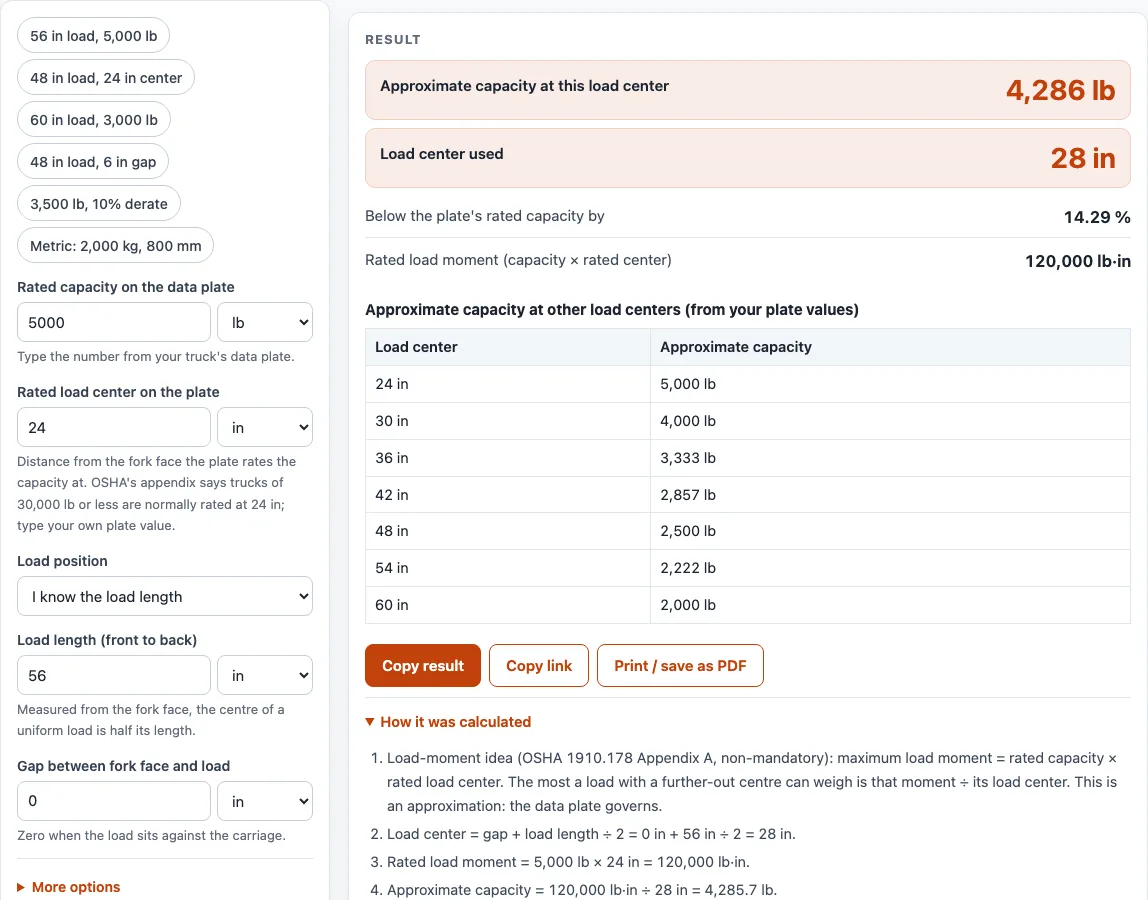
How to use the forklift capacity calculator
- Read the rated capacity and the rated load center from the truck’s data plate. Enter the rated capacity in lb or kg, and the rated load center in in, mm, cm or ft.
- If you know the load length and the gap between the fork face and the load, enter both (centre = gap + length / 2).
- If you already know the load center, enter it directly instead.
- Optionally, enter your load’s weight. The page shows its load moment (weight x load center) and the load as a percent of the approximate capacity: numbers only, no verdict.
- Optionally, enter an attachment derate in percent from the plate or attachment tag. It is applied after the moment estimate.
- Read the approximate capacity. If your load center is shorter than the rated load center, the figure stays at the plate value and the page says the data plate governs.
- Check the table of approximate capacities at 6 inch steps from the rated load center (7 rows, from your plate values).
- A load center over twice the rated one shows a warning: ask the maker or a qualified person for the plate or capacity data.
The presets fill in worked examples: 56 in load / 5,000 lb, 48 in load with the 24 in center (5,000 lb), 60 in load on a 3,000 lb truck (2,400 lb), 48 in load with a 6 in gap (4,000 lb), 3,500 lb load with 10 percent derate (load 90.7 percent of 3,857 lb), and metric 2,000 kg at 800 mm (1,500 kg).
What is the load moment formula behind a forklift capacity calculator?
The estimate uses a load-moment idea: capacity multiplied by the rated load center gives the maximum load moment. OSHA 1910.178 Appendix A, which is non-mandatory, describes it this way. Its example is 3,000 lb at 24 in, which is 72,000 in-lb. A 60 in load has a 30 in center, so it can weigh 72,000 / 30 = 2,400 lb.
How is the load center of a load measured?
The load center is the distance from the fork face to the centre of the load. The tool uses centre = gap + length / 2, so a 56 in load with no gap has a 28 in center. A 48 in load with a 6 in gap has a 30 in center. Appendix A measures from the fork face and notes that the true moment arm is measured from the front wheels, so the fork-face figure is conservative.
Why does a longer load center give a lower approximate capacity?
The formula is approximate capacity = rated capacity x rated load center / actual load center. With the default values, 5,000 lb at 24 in with a 28 in center gives 4,286 lb, which is 14.3 percent below the plate value. In the table, the same plate gives 4,000 lb at 30 in and 2,000 lb at 60 in. The metric example works the same way: 2,000 kg rated at 600 mm, with an 800 mm center, gives 1,500 kg.
Why is the estimate never shown above the data plate value?
If the load center is shorter than the rated load center, the page holds the figure at the plate value. The estimate is only an approximation, and the data plate governs. The page does not consider lift height, mast tilt, tyres, a reach truck or an attachment unless the plate says so. OSHA 1910.178(o)(2) says only loads within the rated capacity of the truck shall be handled.
Where do the sources differ on this estimate?
OSHA’s appendix is non-mandatory. Field guides and a dealer page present the same formula but call it an estimate. The dealer page says it should be used only where the maker’s instructions are not available. The page shows the result as an approximation and does not average the sources. For attachments, 29 CFR 1910.178(a)(5) says user-added front-end attachments are to be marked to show the approximate weight of the combination. Under (a)(4), changes affecting capacity need the maker’s written approval, and the plates must be changed.
Sources (checked 15 October 2026): ecfr.gov · lion.com · summithandling.com · nist.gov
Worked examples
| Input | Result |
|---|---|
| 5000 lb at 24 in, load center 28 in | about 4,286 lb |
| 3000 lb at 24 in, load center 30 in | about 2,400 lb |
| 5000 lb at 24 in, load center 30 in | about 4,000 lb |
| 2000 kg at 600 mm, load center 800 mm | about 1,500 kg |
| 5000 lb at 24 in, load center 28 in | about 3,857 lb |
Calculated by the tool above; open it with the same values to see each step.
Frequently asked questions
Is the forklift capacity calculator the same as a forklift capacity chart?
They answer related questions. A capacity chart lists the capacity printed for a truck, while this tool estimates capacity at a load center you enter. The table on the page gives approximate values at 6 inch steps from your plate values.
What is a forklift load center?
The load center is the distance from the fork face to the centre of the load. The tool calculates it as gap + length / 2, or you can enter it directly. A larger load center usually means a lower capacity.
Can I use the result as the official capacity of my truck?
No. The result is an approximation calculated from your inputs, and the data plate governs. Check the plate on the truck and ask the maker or a qualified person if you are unsure.
What should I do if my load center is more than twice the rated load center?
The moment estimate says little at that distance, so the page shows a warning. Ask the maker or a qualified person for the plate or capacity data for that truck.
Does the tool include an attachment?
Only through the optional attachment derate in percent. Take the figure from the plate or attachment tag. The page does not consider attachments otherwise unless the plate says so.
Is the tool free, and do I need to sign up?
Yes, it is free and needs no sign-up. It runs in your browser, and nothing you type is uploaded.
Related tools
Crane Load Charts: use it to look up load limits on a crane load chart.
Crane Signal Chart: use it when you need the standard hand signals for crane operation.
Sling Angle Calculator: use it to see how sling angle changes the load on each leg of a sling.
Lifting and Rigging: the hub for the sling, forklift and crane tools on this site.
Forklift Inspection Checklist: use it when you want a printable forklift inspection sheet to fill in.
Forklift Maintenance Checklist: use it when you want a printable forklift maintenance sheet to fill in.
Hydraulic Cylinder Force Calculator: use it when you want push and pull force of a cylinder from your own numbers.