Forklift Inspection Checklist
Choose the truck type, add the truck ID and print a blank daily forklift inspection checklist with pass, fail and N/A boxes, a defect log and a sign-off block.
Recent
Your last 10 settings, saved only in this browser. Nothing is uploaded.
How to use the forklift inspection checklist
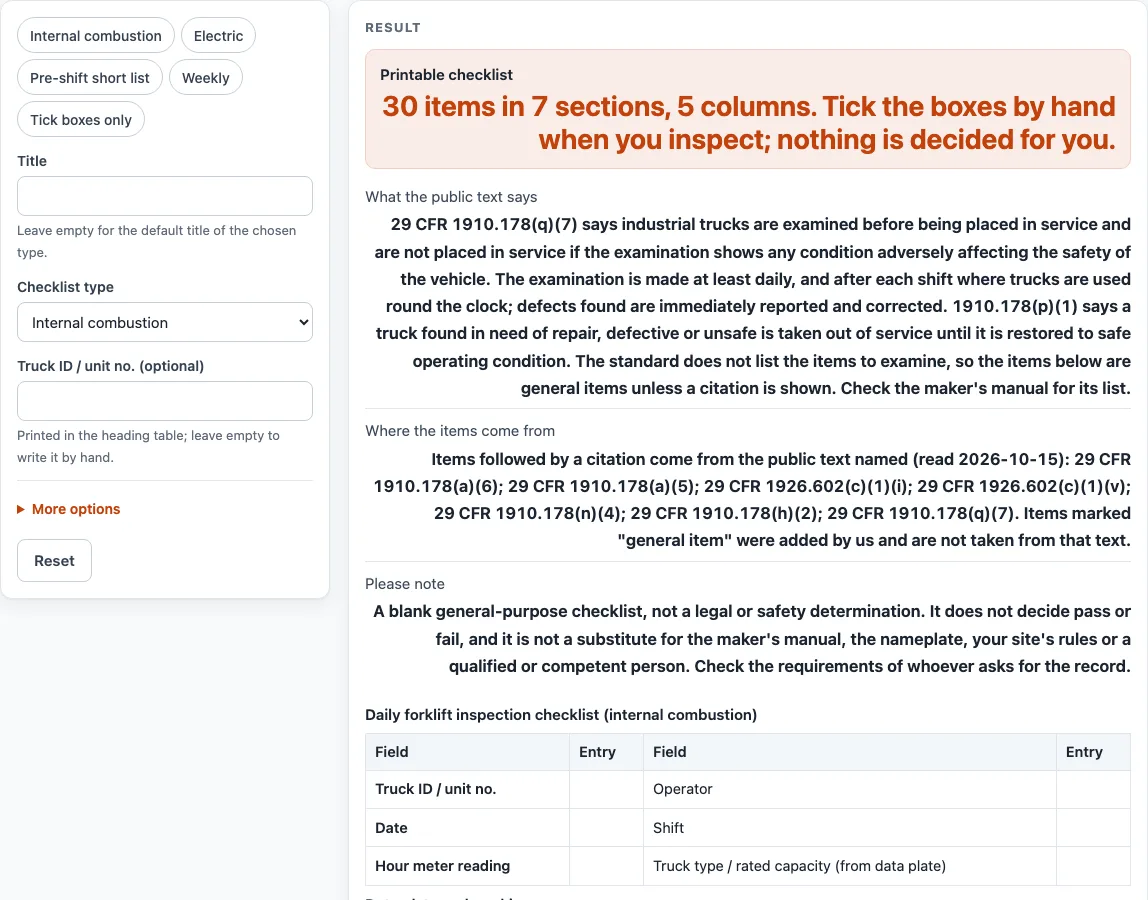
- Choose a “Checklist type”. “Internal combustion” is the default. The other options are “Electric”, “Pre-shift short list” (18 items) and “Weekly (added items)” (39 items).
- Leave “Title” empty to print the default title of the type you chose, or type your own.
- Enter a “Truck ID / unit no. (optional)” to print it in the heading table. Leave it empty if you prefer to write it by hand.
- Under More options, keep “Notes column” on, or turn it off.
- Keep “Show the source after each item” on to see the OSHA paragraph or “general item” after each line. Turn it off to hide these.
- Under More options, turn “Add a defect log” on or off. If it is on, set “Defect log rows” from 0 to 12. The default is 4.
- Turn “Add a sign-off block” on or off. Set “Blank write-in rows” from 0 to 20 for items of your own. The default is 2.
- Read the “Printable checklist” output, then “What the public text says”, “Where the items come from” and “Please note”.
- Print the sheet or save it with Print / save as PDF. To save the tables as a spreadsheet, select “Download as CSV (opens in Excel)”. The file is named forklift-inspection-checklist.csv.
The “Tick boxes only” preset gives a shorter sheet with no notes, source lines, defect log or sign-off block.
What does a daily forklift inspection checklist need to cover?
A daily forklift inspection checklist records the examination that the public text describes. The truck is examined before it is placed in service, and the examination is made at least daily. The sheet here groups its items into seven sections: data plate and markings, walk-around, tires and wheels, forks, mast and hydraulics, operator area and controls, engine, fuel and fluids, and before the truck is used. The internal combustion version has 30 items. The electric version has 29 items and includes battery and electrical items, such as charging only in an area designated for charging.
The short list has 18 items and the weekly type has 39. A defect log table sits below the items when “Add a defect log” is on. Each item is a single condition you can check and mark. For example, “No fluid leaks on the floor under the truck” is one item, and “Tires: no deep cuts, chunks missing or flat spots” is another.
Which OSHA paragraphs does this forklift inspection checklist cite?
Two OSHA general industry paragraphs are the main sources. The first, 29 CFR 1910.178(q)(7), says trucks are examined before being placed in service and are not placed in service if the examination shows a condition that adversely affects safety. The examination is made at least daily, and after each shift where trucks are used round the clock. Defects found are reported immediately and corrected. The second, 29 CFR 1910.178(p)(1), says a truck found in need of repair, defective or unsafe is taken out of service until it is restored to safe operating condition.
The standard does not list the items to examine. For that reason, 22 of the 30 items on the default internal combustion sheet are general items that we added, and they are marked “general item” on the sheet. Items with a citation show the paragraph in brackets. Two citations for rated capacity and the overhead guard come from the construction standard, 29 CFR 1926.602(c), while the daily examination comes from 1910.178. The sheet names each paragraph so you can check which standard applies to your work. The layout, section order and general items are our own design. Check the maker’s manual for its list of items.
Sources (checked 15 October 2026): law.cornell.edu · law.cornell.edu
Worked examples
| Input | Result |
|---|---|
| Checklist type: Internal combustion | 30 items in 7 sections, 5 columns |
| Checklist type: Electric | 29 items in 7 sections, 5 columns |
| Checklist type: Pre-shift short list | 18 items in 6 sections, 5 columns |
| Checklist type: Weekly (added items) | 39 items in 9 sections, 5 columns |
| Checklist type: Internal combustion | 30 items in 7 sections, 5 columns |
Calculated by the tool above; open it with the same values to see each step.
Frequently asked questions
Is this forklift inspection checklist free to use?
Yes. It is free, it runs in your browser, and you do not need to sign up. Nothing you enter is stored or uploaded.
Does the checklist decide whether a forklift passes or fails?
No. It is a blank form. You record what you find by ticking Pass, Fail or N/A. The tool does not make a pass or fail decision for you.
Which checklist type should I choose?
Choose “Internal combustion” for engine-powered trucks and “Electric” for battery-powered trucks. Choose “Pre-shift short list” for a shorter sheet of 18 items, or “Weekly (added items)” for 39 items.
Can I use this as my OSHA checklist?
The sheet cites OSHA paragraphs where the source is clear, but it is a general-purpose form. It is not a legal or safety determination. Check the requirements of whoever asks for the record.
What does the “Tick boxes only” preset change?
It selects the “Pre-shift short list” type (18 items) with the Pass, Fail and N/A boxes only. It turns off the notes column, source lines, defect log and sign-off block, and it adds no write-in rows.
Do I still need the maker’s manual?
Yes. The sheet is not a substitute for the maker’s manual, the nameplate, your site’s rules, or a qualified or competent person.
Related tools
- Crane Inspection Checklist: Use it when you need a printable form for inspecting cranes.
- Equipment Inspection Checklist: Use it when you inspect equipment that is not a forklift.
- Forklift Maintenance Checklist: Use it to plan and record maintenance tasks for a forklift.
- Machine Guarding Checklist: Use it to check the guards on machines in your workplace.
- Equipment Inspection Checklists: Use it to see every inspection checklist on this site.
- Forklift Capacity Calculator: Use it to estimate capacity at another load center from values you type from the data plate.