Heavy Equipment Loan Calculator
Enter the machine price, down payment, trade-in, sales tax, rate and term to see the payment, total interest and a year-by-year payoff table.
Recent
Your last 10 settings, saved only in this browser. Nothing is uploaded.
The heavy equipment loan calculator works out the payment on a loan for heavy equipment from the price, down payment, trade-in, sales tax, fees, interest rate, and term you enter. It also shows total interest, the total of payments, and the total cost of the deal, so you can compare offers before you sign. The same tool answers a construction equipment loan calculator search or a heavy equipment financing calculator search.
The tool runs in your browser. It is free, needs no sign-up, and uploads nothing. Results are calculated from the numbers you type. They show what your inputs produce and are not financial or tax advice. Lender terms, rounding, and fees can differ from these figures, so check your loan documents before you commit.
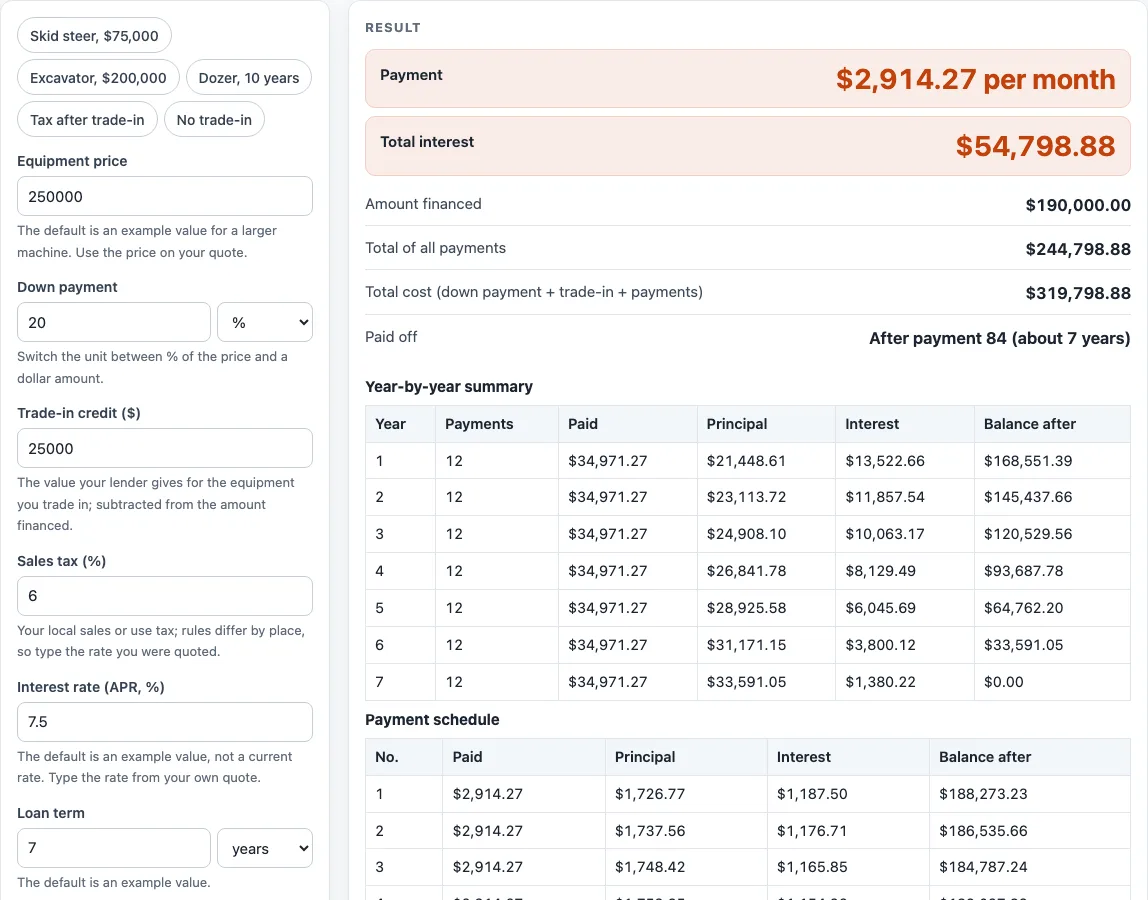
How to use the heavy equipment loan calculator
- Type the price of the equipment.
- Type the down payment, if you are making one, and choose % of the price or a dollar amount.
- Type the trade-in credit in dollars.
- Type the sales tax rate for your area; rules vary by place.
- Type the interest rate (APR, %).
- Type the loan term and choose years or months.
- Open More options. Tick “Charge tax only on price minus trade-in” if tax should be charged on price minus trade-in. Leave it unticked to charge tax on the full price.
- In More options, type any fees financed, and choose Payments: monthly (12 a year) or every 2 weeks (26 a year).
- Optional: in More options, type a first payment date as YYYY-MM-DD to show dates in the payment schedule.
- Optional: in More options, type an extra payment each period.
- Read the results: Payment, Total interest, Total of all payments, Total cost, the year-by-year summary table, and the payment schedule, which shows the first 120 rows. If you added an extra payment, the page also shows “Time saved by the extra payment” and “Interest saved by the extra payment” against the same loan without it.
Change one input at a time to compare offers and see which number moves. Everything stays on the page, and nothing is uploaded, so copy any figures you want to keep before you close the tab.
How is a heavy equipment loan payment calculated?
The payment uses the standard loan formula: Payment = P × i / (1 − (1 + i)^−n). P is the amount financed, i is the periodic interest rate, and n is the number of payments. Each payment covers the interest for that period and reduces the balance by the rest.
At 0% interest the formula does not apply, and the payment is simply P divided by n.
What makes up the amount financed?
The amount financed is P = price − down payment − trade-in + sales tax + fees. The down payment and trade-in reduce what you borrow, while sales tax and fees increase it. Any cost you leave out of these fields is not included in the result.
How does sales tax change the amount financed?
Sales tax is charged on the full price, or on the price minus the trade-in when the box is ticked. Tax rules vary by place, so you type the rate yourself. A higher rate raises P and therefore the payment.
How are total interest and total cost worked out?
The tool builds a payment-by-payment schedule using the unrounded payment. Total interest is the interest charged across that schedule. The total of payments is the sum of all scheduled payments.
Total cost is the down payment plus the trade-in plus the payments. Because it adds your upfront amounts to the loan payments, it shows the full cost of the deal in one figure.
How do payment frequency and the periodic rate change the numbers?
The periodic rate is i = APR / m, where m is the payments per year. The Payments setting offers monthly (12 a year) and every 2 weeks (26 a year). The arithmetic is plain division of the APR by m.
Lenders may calculate biweekly or odd-period loans in their own way. If your lender’s figures differ, ask which method they use.
How do extra payments reduce interest?
An extra payment per period is added to every regular payment. The page compares the result with the same loan run without the extra amount. The gap appears as time saved and interest saved, which show how much sooner the loan can finish and how much interest is avoided, based on your inputs.
Sources (checked 15 October 2026): openstax.org · openstax.org
Worked examples
| Input | Result |
|---|---|
| $250,000.00 at 7.5 % for 7 years | $2,914.27 per month, interest $54,798.88 |
| $250,000.00 at 6.5 % for 3 years | $5,823.31 per month, interest $19,639.18 |
| $250,000.00 at 7.5 % for 7 years | $2,914.27 per month, interest $47,905.71 |
Calculated by the tool above; open it with the same values to see each step.
Frequently asked questions
Frequently asked questions
Does this tool store or upload my numbers?
No. Everything runs in your browser, and nothing is uploaded. You do not need to sign up.
Why might my lender’s payment differ from the result?
Lenders may round differently or calculate biweekly and odd-period loans in their own way. Fees, tax treatment, and rate rules can also differ. Compare the tool’s figures with your loan documents.
What happens if the APR is 0%?
At 0% the payment is the amount financed divided by the number of payments. The standard formula is not needed in that case.
Does the calculator include insurance or maintenance costs?
Only the fields listed on the page are used: price, down payment, trade-in, sales tax, fees, APR, term, frequency, and any extra payment. Other ongoing costs are not included unless you account for them separately.
Why does the payment schedule show only 120 rows?
The schedule displays the first 120 rows. The totals for total interest, the total of payments, and total cost come from the full calculation, not only the rows shown.
Is this financial or tax advice?
No. The results are arithmetic on the numbers you type. For decisions about financing, taxes, or depreciation, speak with a qualified professional.
Related tools
- Equipment Depreciation Calculator: Use it to estimate how the value of equipment may fall over time, based on the numbers you enter.
- Equipment Lease Calculator: Use it when you want to compare a lease with a loan using your own figures.
- Equipment Loan Calculator: Use it for a general loan on equipment when you want the same payment and cost breakdown.
- MACRS Depreciation Calculator: Use it to work out MACRS depreciation from the inputs you provide.
- MACRS Depreciation Table: Use it to look up the MACRS depreciation table values for a reference.
- Semi Truck Loan Calculator: Use it when the financed item is a semi truck.
- Tractor Loan Calculator: Use it when the financed item is a tractor.
- Trailer Loan Calculator: Use it when the financed item is a trailer.