Hydraulic Hose Size Chart
See every dash size with its inside diameter in inches and millimeters, or enter your flow and a target velocity to find the smallest hose that fits.
Recent
Your last 10 settings, saved only in this browser. Nothing is uploaded.
How to use the Hydraulic Hose Size Chart
- In “Flow (Q)”, type your flow and choose gpm or L/min.
- In “Target velocity (v)”, type the velocity you want to design to and choose ft/s or m/s.
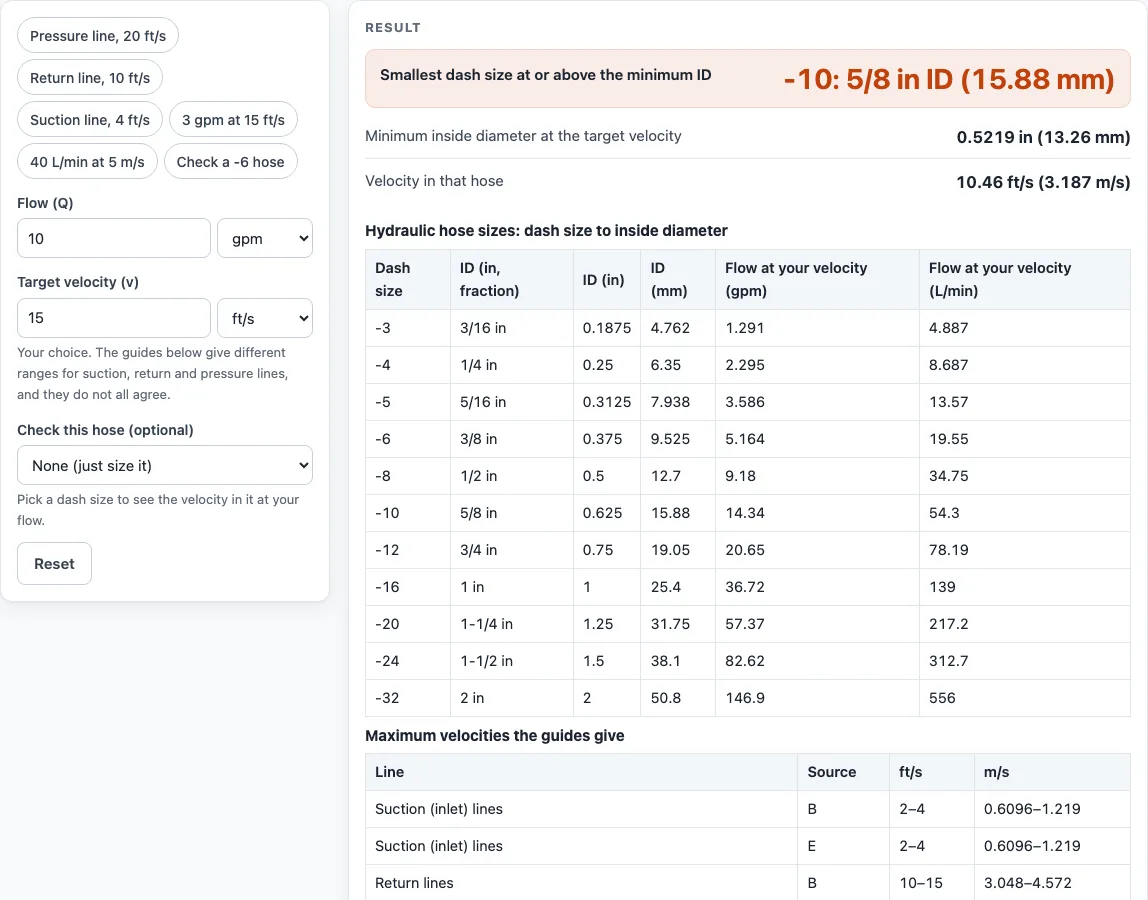
- Read “Minimum inside diameter at the target velocity”. This is the smallest inside diameter that carries your flow at that velocity.
- Read “Smallest dash size at or above the minimum ID”. If the minimum is larger than -32 (2 in), the page says so and names no dash size.
- Read “Velocity in that hose”. This is the velocity in the smallest hose that fits.
- Optional: choose a dash size in “Check this hose (optional)”. Then read “Inside diameter of the hose you picked” and “Velocity in the hose you picked”.
- Compare the velocity with the figures in the velocity table below the tool. If a velocity is above 25 ft/s, the page shows a warning.
- Read the dash-size note under the results. It says that a few hose types use the outside diameter, so check the maker’s data for the hose you use.
The preset chips fill in common cases so you can see how the tool behaves: “Pressure line, 20 ft/s”, “Return line, 10 ft/s”, “Suction line, 4 ft/s”, “3 gpm at 15 ft/s”, “40 L/min at 5 m/s” and “Check a -6 hose”. Select a chip, then change any value to test your own case.
What does a hydraulic hose dash size mean?
For most hose, the dash size is the inside diameter in sixteenths of an inch. So a -8 hose has an inside diameter of 8/16, or 1/2 in. The chart runs from -3 to -32. Some hoses use the outside diameter instead, including SAE 10R5, 100R14, J51 and J2064, so check the maker’s data for the hose you use.
How is the minimum inside diameter calculated?
The tool uses d = √(4Q ÷ (π v)), where Q is flow and v is velocity. In inch units this becomes d = √(0.4085 × Q[gpm] ÷ v[ft/s]), which comes from 231 in³ per gallon. For 10 gpm at 15 ft/s, the result is 0.5218 in, so the smallest hose that fits is -10. Source B prints the constant as 0.4085, and the tool uses the exact value from the derivation, 0.408497. A slow case shows the other end: 20 gpm at 4 ft/s, a suction-line figure, needs 1.429 in, so the smallest dash size is -24 (1-1/2 in). If the minimum is larger than 2 in, the page names no dash size and says so.
Why do maximum velocity figures differ between guides?
Two public guides give the velocity limits in the table below the tool, and they do not match. For suction lines, both give 2 to 4 ft/s. For pressure lines, one guide gives 15 to 20 ft/s at 500 to 2,000 psi and 25 ft/s at 3,000 psi, while the other gives 10 to 15 ft/s up to 500 psi and 15 to 20 ft/s up to 3,000 psi. The figures are shown with their source names and are not averaged. The velocity you type is your own choice.
Why does the page warn above 25 ft/s?
25 ft/s is the highest figure in the two guides, so the warning marks velocities beyond both. For example, 10 gpm in a -6 hose gives 29.05 ft/s. The warning is a comparison against the guides, not a pass or fail result. The metric example works the same way: 40 L/min at 5 m/s needs 13.03 mm, so the smallest dash size is -10.
Sources (checked 15 October 2026): hoseandfittings.com · fastercouplings.com · blog.brennaninc.com · engineersedge.com · nist.gov
Worked examples
| Input | Result |
|---|---|
| 10 gpm at 15 ft/s | Minimum ID 0.5219 in, smallest dash size -10 |
| 20 gpm at 4 ft/s | Minimum ID 1.429 in, smallest dash size -24 |
| 30 gpm at 15 ft/s | Minimum ID 0.9039 in, smallest dash size -16 |
| 40 L/min at 5 m/s | Minimum ID 0.513 in, smallest dash size -10 |
| 10 gpm at 20 ft/s | Minimum ID 0.4519 in, smallest dash size -8 |
Calculated by the tool above; open it with the same values to see each step.
Frequently asked questions
What is the hydraulic hose pipe size for a given flow?
Enter the flow and target velocity, and read “Smallest dash size at or above the minimum ID”. For 10 gpm at 20 ft/s, the minimum inside diameter is 0.4519 in, so the smallest dash size is -8 (1/2 in).
Does a larger dash size always lower the velocity?
Yes. A larger inside diameter carries the same flow at a lower velocity, which is simple arithmetic on the formula. The tool shows the velocity for the hose you pick, so you can compare sizes directly.
Can I use this chart for metric hose sizes?
The chart gives each dash size in millimetres, and the calculator accepts L/min and m/s. It does not give metric DN equivalents, because those differ by maker.
Does the chart show pressure ratings or bend radius?
No. Pressure ratings, plies and bend radius are not given, because they differ by hose maker. Check the manufacturer’s data for those values.
What if the page says the size is above -32?
The minimum inside diameter is larger than 2 in, so no dash size on the chart fits. The page says so instead of naming a size.
Does a result say a hose suits my equipment?
No. The results are calculated from the flow and velocity you enter and what the named sources say. They do not say that any hose suits a particular use, so check your equipment manual and your hose supplier’s documentation.
Related tools
- Hydraulic Cylinder Force Calculator: use it to work out the force a cylinder produces from its bore and pressure.
- Hydraulic Oil Viscosity Chart: use it to compare oil viscosity grades when you are checking a system’s oil.
- JIC Fittings Chart: use it to look up JIC fitting sizes when you are matching fittings to a hose.
- Hydraulics and Fittings: use it to see every hydraulic chart and calculator on the site in one place.
- Preventive Maintenance Checklist: use it when you want a printable checklist for routine machine upkeep.
- Equipment Inspection Checklist: use it when you want a printable form to record what you find on an inspection round.
- Preventive Maintenance Schedule Generator: use it when you want to turn service intervals into due dates to print.