Hydraulic Oil Viscosity Chart
Choose an ISO VG grade to see its midpoint viscosity and limits at 40 degrees C, or type a viscosity to see which grade limits it falls in.
Recent
Your last 10 settings, saved only in this browser. Nothing is uploaded.
How to use the Hydraulic Oil Viscosity Chart
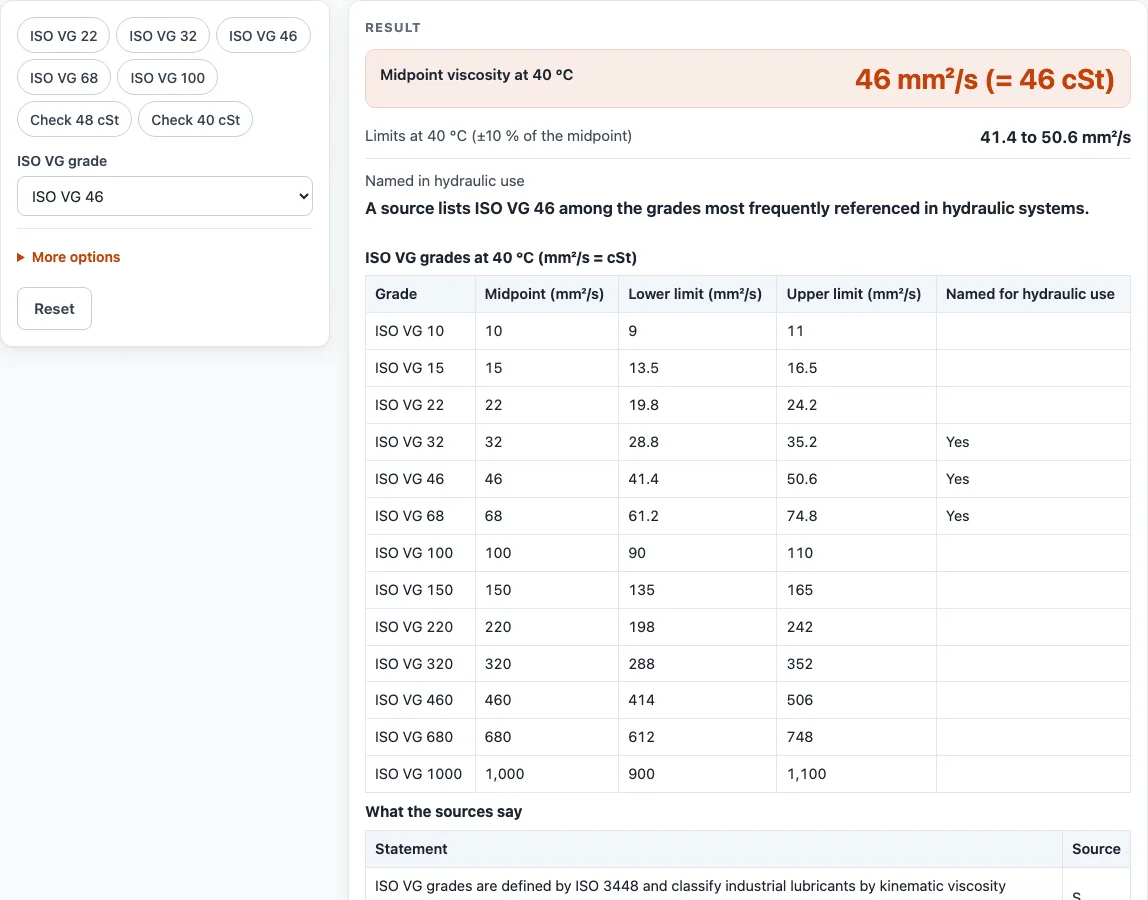
- Open the “ISO VG grade” control and choose a grade. The page opens on ISO VG 46, so that grade is shown first.
- Read “Midpoint viscosity at 40 °C”. For ISO VG 46 it shows 46 mm²/s, which is the same as 46 cSt.
- Read “Limits at 40 °C (±10 % of the midpoint)”. For ISO VG 46 the limits are 41.4 to 50.6 mm²/s.
- Read “Named in hydraulic use”. ISO VG 32, 46 and 68 are the grades one source lists most often in hydraulic systems, and those three rows carry a marker in the chart.
- Open More options and type a value into “A viscosity to check (measured at 40 °C, optional)”. You can enter it in cSt, mm²/s or St.
- Read “Your value in mm²/s” to see the value after conversion. 1 cSt equals 1 mm²/s, and 1 St equals 100 mm²/s.
- Read “Where your value falls”. It says whether the value is within one grade’s limits, between two grades, or outside the range, and how many percent it is from the selected midpoint.
- Compare the result with the machine maker’s viscosity requirement.
The preset chips load common grades in one tap: ISO VG 22, 32, 46, 68 and 100. The chips “Check 48 cSt” and “Check 40 cSt” load example viscosity checks, so you can see how a result reads before you type your own value. Everything is calculated in the browser.
What does ISO VG mean on a hydraulic oil label?
ISO VG is the ISO viscosity grade system, and the number after it is the midpoint viscosity in mm²/s at 40 °C. ISO 3448 defines these grades at 40 °C, with limits of ±10 % of the midpoint. The unit is the same number in cSt and mm²/s, so ISO VG 46 is 46 cSt and 46 mm²/s. One source adds that each grade is about 50 % higher than the one before, which is why the chart steps from 10 to 15, 22, 32, 46 and 68. The same source names ISO VG 32, 46 and 68 as the grades most frequently referenced in hydraulic systems. The grade defines viscosity only. It says nothing about additives, base oil or performance.
How are the lower and upper limits worked out?
Each limit is a fixed percentage of the midpoint. The lower limit is 90 % of the midpoint and the upper limit is 110 %. For ISO VG 32 that gives 28.8 to 35.2 mm²/s (32 × 0.9 = 28.8, and 32 × 1.1 = 35.2). For ISO VG 1000 it gives 900 to 1,100 mm²/s. The same rule applies to every row, so the limits scale with the midpoint.
How is a measured value compared with a grade?
The page converts your value to mm²/s, then checks it against each grade’s limits. The percentage from the midpoint is calculated as (your value − midpoint) ÷ midpoint × 100. For example, 48 cSt against ISO VG 46 gives (48 − 46) ÷ 46 × 100 = +4.348 %, and 48 falls within the limits of ISO VG 46. A value of 40 cSt lies between the limits of ISO VG 32 (upper limit 35.2) and ISO VG 46 (lower limit 41.4).
Why do sources differ, and what does the chart leave out?
Sources do not always print the same numbers. One source gives 29.8 mm²/s as the minimum for ISO VG 32 and 41.1 for ISO VG 46. The ±10 % rule and two other sources give 28.8 and 41.4, and the page uses those values. Another source prints the reference temperature as “10 °F (40 °C)”, which is treated here as a typing error for 40 °C. A third source says “defined tolerance limits” without giving the number, and the ±10 % comes from the other sources.
All figures are at 40 °C, and the viscosity at working temperature is different. The chart does not tell you what a machine needs, which is why the machine maker’s requirement comes first.
Sources (checked 15 October 2026): engineersedge.com · wiki.anton-paar.com · sinopeconline.com · olezol.com
Worked examples
| Input | Result |
|---|---|
| ISO VG 46 | Midpoint 46, limits 41.4 to 50.6 mm²/s |
| ISO VG 32 | Midpoint 32, limits 28.8 to 35.2 mm²/s |
| ISO VG 68 | Midpoint 68, limits 61.2 to 74.8 mm²/s |
| ISO VG 46, checking 48 cSt | Midpoint 46, limits 41.4 to 50.6 mm²/s |
| ISO VG 46, checking 40 mm²/s | Midpoint 46, limits 41.4 to 50.6 mm²/s |
| ISO VG 100, checking 1 St | Midpoint 100, limits 90 to 110 mm²/s |
Calculated by the tool above; open it with the same values to see each step.
Frequently asked questions
Does this chart tell me which hydraulic oil grade my machine needs?
No. The page does not recommend a grade for any machine. Follow the machine maker’s viscosity requirement.
Why does my reading at working temperature differ from the chart?
Every number on the chart is at 40 °C, and oil at working temperature has a different viscosity. Type only values measured at 40 °C into the “A viscosity to check” field.
Is 48 cSt the same as 48 mm²/s?
Yes. 1 cSt equals 1 mm²/s, so the page shows the same number in both units. A value in St is converted at 1 St = 100 mm²/s.
Why do other sites list different limits for ISO VG 32?
Sources do not always agree. One gives 29.8 mm²/s as the minimum for ISO VG 32, while the ±10 % rule and two other sources give 28.8 mm²/s. The page uses 28.8 to 35.2 mm²/s.
Does a result on this page say my oil suits my machine?
No. The page reports arithmetic against the chart: whether a number falls within, between or outside the limits, and its percentage from the midpoint. It does not say whether any machine, oil or system suits its purpose.
Is anything I type uploaded anywhere?
No. The tool is free, needs no sign-up, and everything is calculated in your browser.
Related tools
- Hydraulic Cylinder Force Calculator: use it when you want to run cylinder force arithmetic on your own numbers.
- Hydraulic Hose Size Chart: use it when you are checking hose sizes for a hydraulic line.
- JIC Fittings Chart: use it when you are looking up JIC fitting sizes for a hydraulic connection.
- Hydraulics and Fittings: use it to see every hydraulic chart and calculator on the site in one place.
- Preventive Maintenance Checklist: use it when you want a printable checklist for routine machine upkeep.
- Equipment Inspection Checklist: use it when you want a printable form to record what you find on an inspection round.
- Preventive Maintenance Schedule Generator: use it when you want to turn service intervals into due dates to print.