JIC Fittings Chart
Pick a dash size for its tube outside diameter and 37 degree flare thread, or type a measured thread such as 9/16-18 to find the dash size.
Recent
Your last 10 settings, saved only in this browser. Nothing is uploaded.
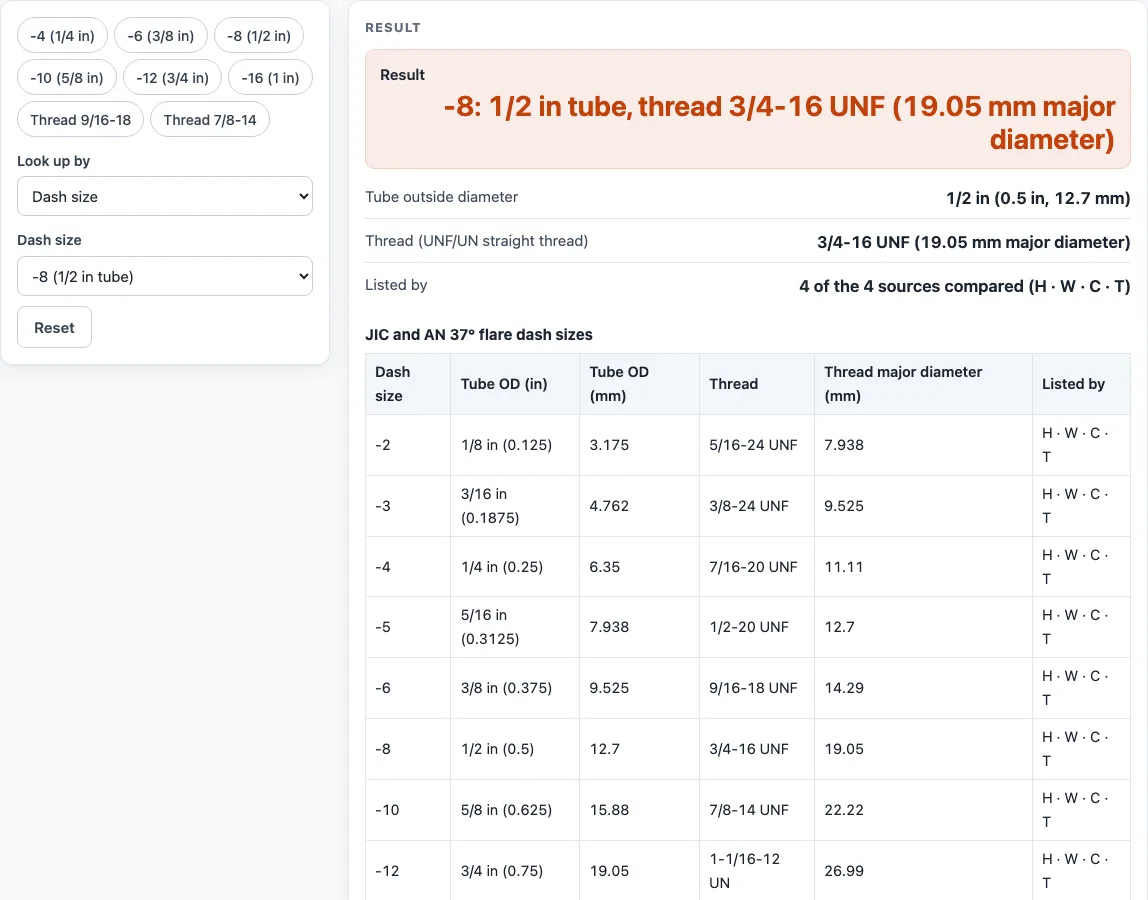
How to use the JIC Fitting Size Chart
- Set “Look up by” to dash size.
- In “Dash size”, keep the starting value of -8, or choose another dash size from the list.
- Read “Tube outside diameter”. For -8 this is a 1/2 in tube.
- Read “Thread (UNF/UN straight thread)”. For -8 this is 3/4-16 UNF, with a 19.05 mm major diameter.
- Read “Listed by” to see which of the four sources list that size. If a size is listed by fewer than three sources, the page shows a warning.
- Set “Look up by” to Thread, then use the “Thread (size-TPI)” box.
- Type a thread such as 9/16-18, 7/8-14, 1-1/16-12 or 1 1/16 x 12 UN.
- Read “Result” for the dash size. For 9/16-18 the result is -6, and for 7/8-14 it is -10. The page also shows the tube outside diameter and thread for that row.
- If the thread is not in any row, such as 7/16-18, the page gives a “no dash size” message. Check your thread by measurement before you search again.
- When no row matches, “Thread lookup” shows the message that no dash size in the sources has your thread.
The preset chips load sample sizes into the inputs so you can check them quickly. They include “-4 (1/4 in)”, “-6 (3/8 in)”, “-8 (1/2 in)”, “-10 (5/8 in)”, “-12 (3/4 in)”, “-16 (1 in)”, “Thread 9/16-18” and “Thread 7/8-14”. Nothing you enter is uploaded.
What does a JIC fitting size chart show?
A JIC fitting size chart matches a dash size to a tube outside diameter and a straight thread. JIC and AN fittings both use a 37° flare, and the chart covers those 37° flare sizes only. Each row gives one dash size, its tube, its thread and the thread’s major diameter in millimetres.
The dash number counts sixteenths of an inch. The tube outside diameter is the dash number divided by 16, so -8 is 8/16, or 1/2 in. The chart gives the fraction, the decimal inches and the millimetres for each tube. The thread is written as size and threads per inch, such as 3/4-16 for -8. The sizes run from -2 (5/16-24) up to -32 (2-1/2-12).
The four sources agree on every thread they list, but they do not agree on which sizes to include. One source lists -2 to -20 only. Another lists -2 to -24. One source leaves out -14 and adds -28 and -32, and another adds -32 but not -28. The “Listed by” output shows this for each size. A size that only one or two sources list is not a reason to reject it, but it is a reason to check the thread against the maker’s data.
Only one source names the thread form as UNF or UN. The others give the size and threads per inch only, and one of them labels it SAE. The page shows UNF for -2 to -10 and UN for -12 to -20 where a source names the form.
How do the sources describe JIC and AN?
The sources disagree on whether JIC and AN can be used together. One source says JIC is dimensionally identical to AN but is made to less exacting tolerances. Another says AN uses class 3A/3B UNJ/UNJF root threads, JIC uses class 2A/2B UN/UNF, the two are not interchangeable, and mixing them is not recommended. The page shows both statements with their source names and does not decide between them.
A separate point is the SAE 45° flare. One source says SAE 45° flare fittings look similar to 37° flare fittings but are not interchangeable with them. NPT, BSP, ORFS, SAE 45° flare and metric threads also look similar to the threads on this chart, so identify your thread by measurement and by the maker’s data before you choose a fitting.
Sources (checked 15 October 2026): hoseandfittings.com · en.wikipedia.org · chasebays.com · tameson.com
Worked examples
| Input | Result |
|---|---|
| Dash -8 | Dash -8, thread 3/4-16 |
| Dash -4 | Dash -4, thread 7/16-20 |
| Dash -12 | Dash -12, thread 1-1/16-12 |
| Thread 9/16-18 | Dash -6, thread 9/16-18 |
| Thread 1 1/16 x 12 UN | Dash -12, thread 1-1/16-12 |
| Thread 7/16-18 | No match in the chart |
Calculated by the tool above; open it with the same values to see each step.
Frequently asked questions
What does the dash number on a JIC fitting size chart mean?
The dash number is the tube outside diameter in sixteenths of an inch. For example, -8 means 8/16 in, which is a 1/2 in tube. The thread for that size is listed separately.
Why does a size show “Listed by” fewer than four sources?
The four sources do not list the same sizes. -28 appears in one source only, and -14, -24 and -32 appear in three or fewer. When a size is listed by fewer than three sources, the page shows a warning.
Is JIC the same as AN?
The sources do not agree. One says JIC is dimensionally identical to AN with looser tolerances, while another says they are not interchangeable and mixing is not recommended. The page shows both statements and does not choose one.
Does this chart confirm that my fitting is the right one?
No. Results are calculated from your inputs or show what the named source says. Confirm the thread by measurement and the maker’s data.
What if my thread is not found?
A thread that is not in any row, such as 7/16-18, gets a “no dash size” message. That means the chart has no matching line for that thread. Measure the thread again and check the maker’s data before you search again.
Does this tool cover NPT, BSP or metric threads?
No. The page covers 37° flare fittings only. NPT, BSP, ORFS, SAE 45° flare and metric threads look similar to these threads, so identify them separately.
Related tools
- Hydraulic Cylinder Force Calculator: Use it when you need to work out force from your own cylinder numbers.
- Hydraulic Hose Size Chart: Use it when you are matching hose sizes rather than fitting sizes.
- Hydraulic Oil Viscosity Chart: Use it when you need to compare oil viscosity values.
- Hydraulics and Fittings: use it to see every hydraulic chart and calculator on the site in one place.
- Preventive Maintenance Checklist: use it when you want a printable checklist for routine machine upkeep.
- Equipment Inspection Checklist: use it when you want a printable form to record what you find on an inspection round.
- Preventive Maintenance Schedule Generator: use it when you want to turn service intervals into due dates to print.