Sling Angle Calculator
Enter the load weight, the number of legs and the sling angle, or the leg length and spread, to see the load factor and the tension in each leg.
Recent
Your last 10 settings, saved only in this browser. Nothing is uploaded.
How to use the sling angle calculator
- Type the load weight in the weight field. You can use lb, kg, US ton (2,000 lb) or tonne. The leg tension is shown in the same unit.
- Under “Legs on the sling,” choose 2, 3 or 4.
- If you chose 3 or 4 legs, check the second choice, “legs carrying the load,” and set it to the number of legs you expect to carry the load. The default counts 2 legs.
- Pick one way to give the geometry:
- Angle from horizontal.
- Angle from vertical.
- Sling leg length with the spread between the lift points.
- Sling leg length with the height from the lift points to the hook.
- Type the number for that geometry. Lengths can be in ft, in, m or mm.
- Read the angle from horizontal, the angle from vertical, the load factor and the tension in each leg.
- If you have a rated capacity from your own sling tag, enter it. The page then shows either the leg tension as a percent of one leg’s capacity, or the load as a percent of the tag value for the whole sling at this angle.
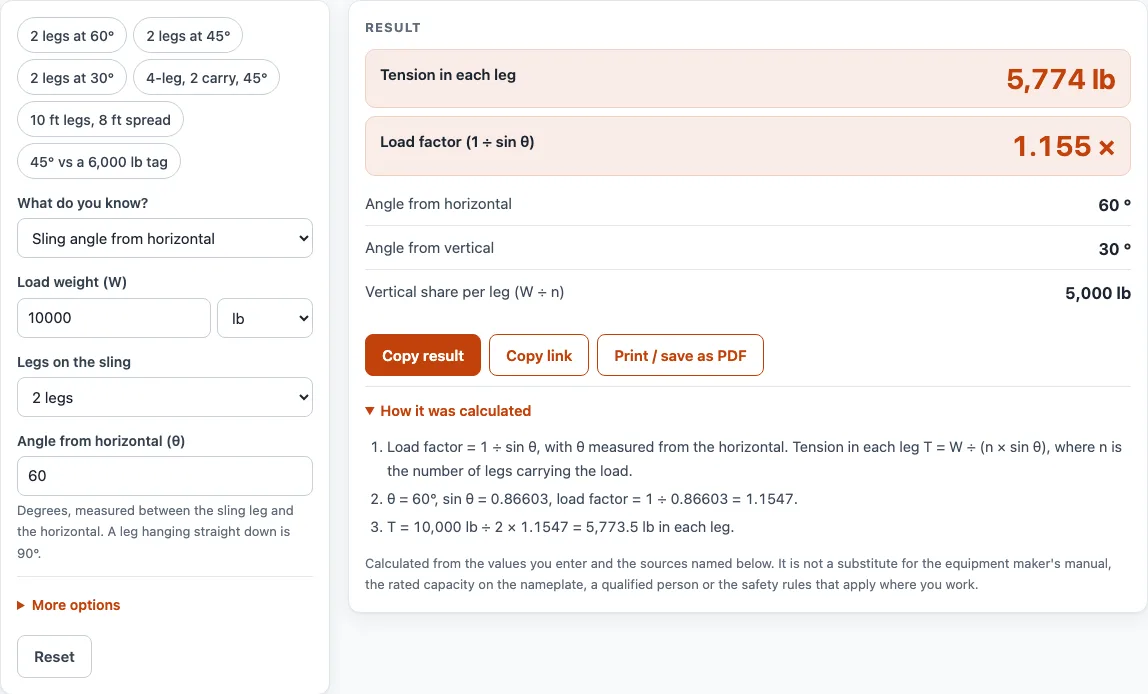
To start from an example, use one of the presets: 2 legs at 60, 45 or 30 degrees; a 4-leg sling with 2 legs carrying at 45 degrees; a 10 ft leg with an 8 ft spread; or 45 degrees compared with a 6,000 lb tag value.
What is the sling angle and how is it measured?
The sling angle is the angle each leg makes with the horizontal. The angle from vertical is 90 degrees minus the angle from horizontal, so a 60-degree angle from horizontal is 30 degrees from vertical. The page accepts an angle from horizontal above 0 and up to 90 degrees.
How is the tension in each sling leg calculated?
Each leg carries T = W / (n × sin θ), where W is the load weight, n is the number of legs counted as carrying the load, and θ is the angle from horizontal. All legs are taken at the same angle and are assumed to share the load equally. This is textbook statics, not a sling rating. For 10,000 lb on 2 legs at 60 degrees, the load factor is 1 / sin 60°, which is 1.155, and each leg carries 5,774 lb. At 30 degrees the load factor is 2, so each leg of a 2-leg sling carries the whole 10,000 lb.
How do leg length and spread or height give the angle?
With the spread, cos θ = half the spread divided by the leg length. With a 10 ft leg and an 8 ft spread, cos θ is 0.4, the angle is 66.42 degrees, and each leg of a 2-leg sling carries 5,455 lb for 10,000 lb. With the height, sin θ = height divided by leg length. A 10 ft leg with a 6 ft height gives sin θ of 0.6 and 8,333 lb per leg. The spread method assumes a symmetric pair of equal legs, each running half the spread horizontally. If half the spread or the height is greater than the leg length, the page shows “a leg cannot reach.”
What do the angle limits and leg counts mean for the result?
Sources differ on the lowest angle they mention. The OSHA guidance on safe sling use says slings with horizontal angles less than 30 degrees should not be used. One rigging supplier calls 30 degrees the practical lower boundary and strongly advises against going below it. Hoist magazine describes a general-purpose rated range of 45 to 90 degrees from horizontal and an extended range of 30 to 45 degrees. The page shows each of these as what the named source says and does not average them.
For 3- or 4-leg slings, sources agree that rated capacity assumes load sharing and that a rigid load may load only two legs. The two-thirds derating factor comes from Hoist magazine and one maker catalog, so the page names it as the guide’s statement only. 29 CFR 1910.184 says slings shall not be loaded in excess of their rated capacities, and the rating comes from your sling tag, which governs. The page shows only a percentage and gives no verdict.
Sources (checked 15 October 2026): osha.gov · ecfr.gov · hoistmagazine.com · hhilifting.com · nist.gov
Worked examples
| Input | Result |
|---|---|
| 10000 lb, 2 legs carrying, 60° | load factor 1.155, 5,774 lb per leg |
| 10000 lb, 2 legs carrying, 45° | load factor 1.414, 7,071 lb per leg |
| 10000 lb, 2 legs carrying, 30° | load factor 2, 10,000 lb per leg |
| 10000 lb, 2 legs carrying, 66.42° | load factor 1.091, 5,455 lb per leg |
| 4000 kg, 2 legs carrying, 45° | load factor 1.414, 2,828 kg per leg |
Calculated by the tool above; open it with the same values to see each step.
Frequently asked questions
What does the load factor mean?
The load factor is 1 divided by sin of the angle from horizontal. It shows how much the tension in each leg is multiplied compared with the load, so at 60 degrees it is 1.155 and at 30 degrees it is 2.
Why does the default count only 2 legs for a 3- or 4-leg sling?
A rigging guide says a rigid load on a 3- or 4-leg sling may be carried by only two legs, and the default follows that statement. You can change the number in “legs carrying the load” if your own situation differs. The page will show the warning for 3 or 4 legs in either case.
Which units can I type?
Load weight can be entered in lb, kg, US ton (2,000 lb) or tonne. Lengths can be entered in ft, in, m or mm. Conversions use the exact NIST SP 811 factors, and the leg tension is shown in the same unit as the load.
Can I compare a result with my sling tag?
Yes. Enter the capacity of one leg for a straight pull, or the tag value for the whole sling at this angle, and the page shows the result as a percent. For example, 45 degrees with a 6,000 lb tag value gives 7,071 lb, which is 117.9 percent of the tag value.
Does a result tell me whether my lift is acceptable?
No. The result is calculated from the values you typed and is not a decision about the lift. The sling tag, the maker’s manual and a qualified person decide how the sling is used.
What warnings does the page show?
It shows a warning below 30 degrees from horizontal, which repeats the OSHA guidance. It also shows a warning from 30 up to 45 degrees, which notes the rigging guide’s extended range and that the tag lists ratings at stated angles. Each warning names its source.
Related tools
Crane Load Charts: use when you need to read load limits from a crane chart rather than work out sling tension.
Crane Signal Chart: use when you need a reference of hand signals to share with a crane team.
Forklift Capacity Calculator: use when you want to check how a load’s position changes forklift capacity.
Lifting and Rigging: the hub for the sling, forklift and crane tools on this site.
Crane Inspection Checklist: use when you want a printable crane and sling inspection sheet to fill in.
Forklift Inspection Checklist: use when you want a printable forklift inspection sheet to fill in.
Hydraulic Cylinder Force Calculator: use when you want push and pull force of a cylinder from your own numbers.