Truck Inspection Checklist
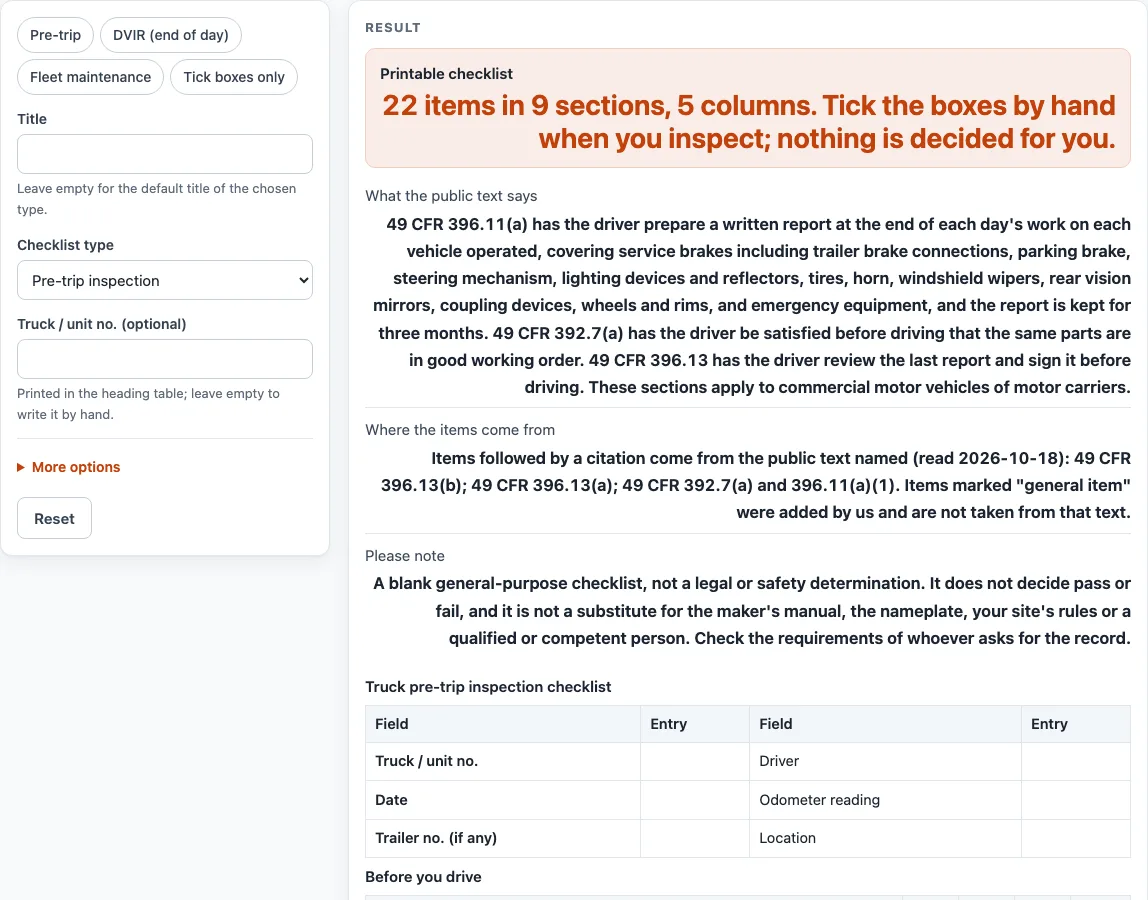
Choose the pre-trip, DVIR or fleet maintenance list, add the truck number and print a blank checklist with pass, fail and N/A boxes, a defect log and a sign-off block.
Recent
Your last 10 settings, saved only in this browser. Nothing is uploaded.
How to use the truck inspection checklist
- Under “Checklist type”, choose “Pre-trip inspection” (the default), “Driver vehicle inspection report (end of day)” or “Fleet maintenance and records check”.
- Change the “Title” if you want a different heading, and type the “Truck / unit no. (optional)” if you want it printed. Leave it empty to write it by hand.
- Under More options, switch the “Notes column”, “Show the source after each item”, “Add a defect log” and “Add a sign-off block” on or off. “Defect log rows” and “Blank write-in rows” set how many empty rows are added.
- Check the sheet in the result panel. The heading table has Truck / unit no., Driver, Date, Odometer reading, Trailer no. (if any) and Location to fill in by hand.
- Press “Print / save as PDF” to print it, or download the CSV, then tick Pass, Fail or N/A on each item at the truck.
The example buttons “Pre-trip”, “DVIR (end of day)”, “Fleet maintenance” and “Tick boxes only” load ready-made versions that you can then change. The “DVIR (end of day)” list follows the 11 parts named in 49 CFR 396.11, so use it when you write the daily report, and use “Pre-trip inspection” before you drive. “Copy link” keeps your settings in the page address.
What do the pre-trip rules ask a driver to check?
49 CFR 392.7(a) says that before driving a commercial motor vehicle, the driver must be satisfied that service brakes (including trailer brake connections), the parking brake, steering, lights and reflectors, tires, horn, windshield wipers, rear-vision mirrors, coupling devices, wheels and rims, and emergency equipment are in good working order. The “Pre-trip inspection” type groups 22 items into 9 sections that cover these parts, plus a Walk-around section for leaks, body damage, the fuel cap and the load.
What is a driver vehicle inspection report?
A driver vehicle inspection report is a written report that the driver prepares at the end of each day’s work on each vehicle operated, under 49 CFR 396.11(a). Each vehicle gets its own report. The driver lists any defect that would affect safe operation or cause a mechanical breakdown, and signs it. If there is no defect, no report is needed under this section. Before the vehicle is driven again, the carrier or its agent certifies that the listed defects were repaired or that repair is unnecessary. The report, the certification and the driver’s review are kept for three months from the report date. The section does not apply to, among others, carriers operating only one commercial motor vehicle. The “Driver vehicle inspection report (end of day)” type follows the 11 parts named in 396.11(a)(1).
What do the maintenance and records rules require?
49 CFR 396.3 says motor carriers must systematically inspect, repair and maintain the vehicles they control. Parts such as frames, suspension, axles, wheels, rims and steering must be in safe and proper operating condition at all times. Each vehicle’s records must show its identification, a way to show the type and due date of each inspection and maintenance task, and the date and nature of each job. The “Fleet maintenance and records check” type has 13 items in 2 sections. The sheet uses the retention sentence in 396.3(c), which sets one year where the vehicle is housed or maintained, plus six months after it leaves the carrier’s control.
49 CFR 396.17 adds that a commercial motor vehicle may not be used unless each component in the periodic inspection appendix has passed an inspection at least once in the preceding 12 months.
Sources (checked 18 October 2026): law.cornell.edu 392.7 · 396.3 · 396.11 · 396.13 · 396.17
Worked examples
| Input | Result |
|---|---|
| Checklist type: Pre-trip inspection | 22 items in 9 sections, 5 columns |
| Checklist type: Driver vehicle inspection report (end of day) | 15 items in 8 sections, 5 columns |
| Checklist type: Fleet maintenance and records check | 13 items in 2 sections, 5 columns |
| Checklist type: Pre-trip inspection | 22 items in 9 sections, 5 columns |
Calculated by the tool above; open it with the same values to see each step.
Frequently asked questions
Is this truck inspection checklist a legal form?
No. It is a blank, general-purpose checklist and not a legal or safety determination. The rules it draws on apply to commercial motor vehicles of motor carriers under FMCSA rules.
Does the tool decide whether a truck passes?
No. You mark Pass, Fail or N/A on each item yourself, and the sheet makes no decision for you.
Can I use it as a semi truck pre trip inspection checklist?
Yes. Choose “Pre-trip inspection”, which lists 22 items in 9 sections. A small business pickup can use the same list as good practice.
What is the difference between a pre-trip check and a DVIR?
A pre-trip check happens before you drive. A driver vehicle inspection report is written at the end of the day’s work and signed by the driver.
Is my data saved anywhere?
No. Nothing is stored or uploaded. Print the sheet or download the CSV to keep a copy.
Which rules does the sheet use?
It uses 49 CFR 392.7(a), 396.3, 396.11, 396.13 and 396.17. Check the official text before relying on it.
Can I use the printed checklist in my business?
Yes. The sheets you print or download may be used in commercial work, for your own fleet or for clients, with no attribution.
Related tools
- Fire Extinguisher Inspection Checklist — a monthly and annual checklist for the extinguisher on the truck
- Equipment Inspection Checklist — a general inspection form for equipment that is not a truck
- Forklift Inspection Checklist — a daily pre-shift form for forklifts
- Preventive Maintenance Schedule — turn maintenance tasks and intervals into due dates
- Semi Truck Loan Calculator — estimate the payment on a semi truck loan
- Trailer Loan Calculator — estimate the payment on a trailer loan
- Equipment Inspection Checklists — every inspection checklist on this site